Whether you make lists on scraps of paper, the fridge, in a notebook, or on your phone. I am sure, like me, you have at some point had to tackle the dreaded to-to list.
Do you have that list that is forever growing and you feel so overwhelmed you do not even know where to begin? Yes, I know the one!
I have a notes app on my phone (OneNote if you are interested) which handily lets you set up virtual notebooks, sections, and pages, to help you organise everything. I have a note in there which for the longest time was my “to-do” list. I add things as I think of them, and remove things once they are done. Some things have been on there for a long time, and other things come and go within a day.
But there is power in those two little words – To do.
To Do
To do. Things you haven’t done yet. Things waiting for you. Things that need doing before you can rest, before you’ve earned your day, before you’re allowed to just exist without a sense of something looming.
For anyone who experiences task paralysis (I will talk more about this below) that particular flavour of overwhelm where the list itself becomes the thing stopping you from starting (anything, just one small thing…) the words “to do” can quietly reinforce the feeling that you’re already behind before you’ve even got up.
So I changed two words. That’s all.
The power of possibilities
My list is now called “Possibilities.”
So now, in the morning instead of asking myself what do I need to do today I ask: what possibilities await me today?
It sounds small. It is small. But language shapes how we feel about things, and ourselves. Changing two little words has more power than you could imagine.
A possibility is something available to you. Something you could choose. Something that might happen if conditions are right and you feel up to it. It doesn’t demand anything. It just sits there, gently, waiting to see what you make of it.
Some days I work through most of the list. Some days I do one thing. Some days I look at it, decide none of it is possible today, and close my phone. Not one of those options or days is a failure, because a list of possibilities doesn’t fail. It just waits (unlike that judging to-do list!)
A note on task paralysis
If you’ve never experienced task paralysis it can be hard to explain. It’s not laziness. It’s not even procrastination in the way most people understand it. It’s more like a kind of freeze, where the gap between where you are and where the task needs you to be feels so wide that your brain simply can’t build a bridge across it.
Common in anxiety, depression, ADHD and trauma responses, task paralysis often gets worse the more important the task feels. The higher the stakes, the wider the freeze.
Reframing the list won’t cure task paralysis. But it can quietly reduce the pressure that makes it worse. And sometimes that’s enough to get started.
Another handy tip I have for task paralysis is to break bigger tasks down into smaller tasks. So instead of one task that will take you an hour to complete, try and complete a 10 or even 5 minutes worth of mini tasks (building towards the main tasks) and tick those off as done. If you feel up it it then try another mini-task. Before you know it that looming task you have been putting off has been done and can be ticked off (or deleted from) your list.
Mini Task example
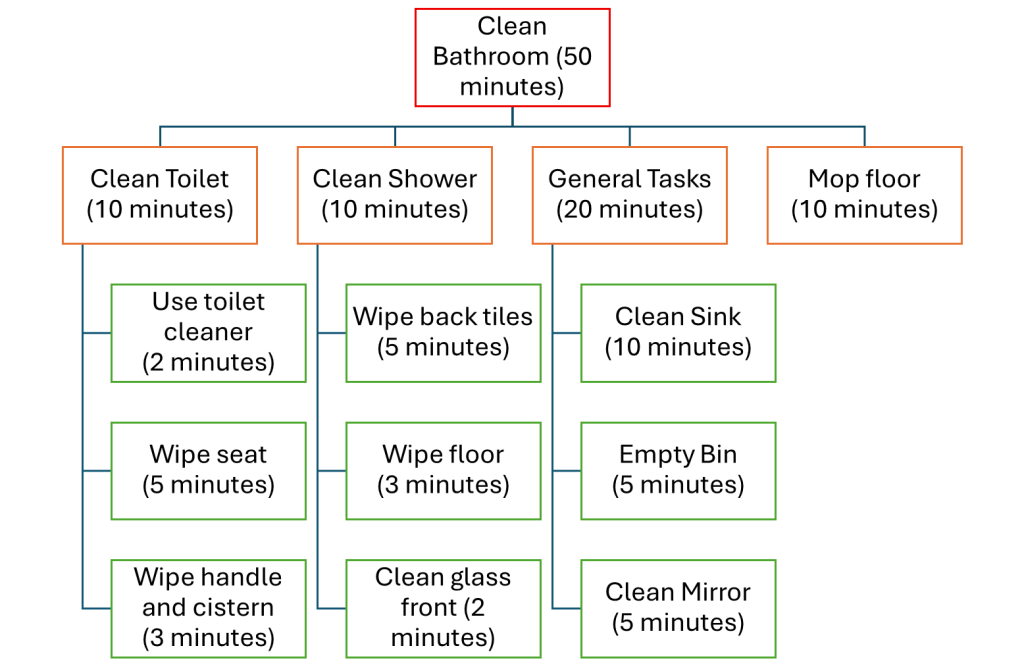
The example in the image above shows how you can break a task down into smaller ones.
Clean Bathroom for 50 minutes can be broken down further:
- Clean toilet (10 minutes)
- Clean shower (10 minutes)
- General tasks (20 minutes)
- Mop floor (10 minutes)
But if those tasks seem too much then you can break it down even further:
For example Clean Toilet for 10 minutes becomes:
- Use toilet cleaner (2 minutes)
- Wipe seat (5 minutes)
- Wipe handle and cistern (3 minutes)
Try it if you want
Rename your list. Change the question you ask yourself in the morning. See if it shifts anything, even slightly. Also try mini-tasks if that will be helpful for you.
You don’t have to do everything on it today. You just have to see what’s possible.

Emily is a life and mindfulness coach at The Stillth Grove, working with people navigating transition, mental health recovery and the impact of the criminal justice system. If any of this resonates, feel free to get in touch.